
GOLDEN HILLS RC&D
  • Home
  • About Us
    • Contact Us
    • Job Openings
    • Who We Are
    • Where We Work
    • What We Do >
      • Community Partnerships
      • Arts and Culture
      • Water Resources
      • Local Foods
      • Outdoor Recreation & Tourism
      • Land Stewardship
    • News
  • Events
  • Donate to Golden Hills

News

Golden Hills' blog. To sign up for our newsletter, visit goldenhillsrcd.org/newsletters

East Nishnabotna Fish Kill Updates - March 2024

3/21/2024

0 Comments

 
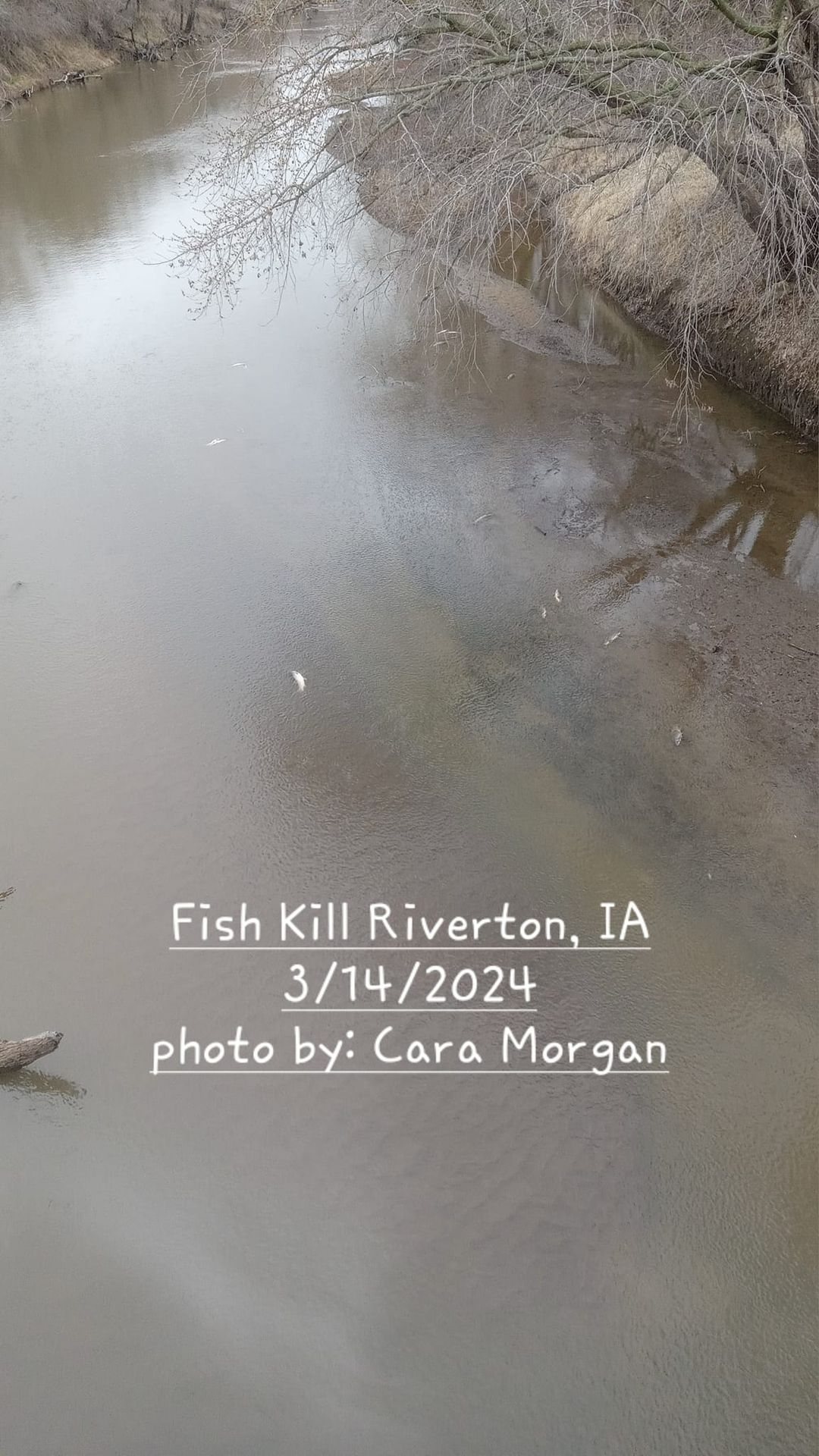
You probably heard about the recent fertilizer spill and fish kill on the East Nishnabotna River near and south of Red Oak. 

According to Iowa Department of Natural Resources (DNR), a
pproximately 1,500 tons of liquid nitrogen fertilizer--with 32% solution--was discharged into a drainage ditch near Red Oak. 

A survey of a stretch of the river south of Red Oak indicated few if any living fish. The plume of nitrogen flowed downstream past the confluence with the West Nishnbotna, impacting the Nishnabotna River all the way to its confluence with the Missouri River in northwestern Missouri.

Here are a few things we know and don't yet know, confirmed by Iowa DNR staff:
  • According to DNR staff, “about 1,500 tons of liquid nitrogen fertilizer (32% solution) discharged into a drainage ditch, then into the East Nishnabotna River.” 
  • Many small fish like minnows and shiners were killed. These populations also live in many of the tributaries and should repopulate the Nish fairly quickly 
  • Some of the dead fish are grass carp, but not many dead Asian carp have been found.
  • Most of the larger game fish spend their winters in the Missouri River and had not yet made their way back up the Nish, so they should largely be fine. The low water levels from a few years of drought helped with this, as some of these fish typically would have been in the Nish but migrated to the Missouri for deeper waters.
  • There is a concern for reptiles and amphibians including turtles that burrow into the river bottoms for winter hibernation. They likely were unable to escape and the full extent of these casualties and may not be seen until their bodies float up out of the silt 
  • It appears that the fish killed were killed from the nitrogen entering their gills, but fish tissues have not been tested. It’s possible the nitrates did not absorb much into their bodies. If this is the case, there would not a major concern for predators or scavengers like eagles that may consume the dead fish, but this has yet to be confirmed.​
Video above from Chad Tiemeyer on Facebook, footage taken by Todd Meyer. 
Rivers are incredibly resilient systems, and the constant flow means that the excess nitrogen will eventually be flushed out of the river. Nitrate levels in the river are already back to pre-spill levels near Red Oak.

As a precaution, people may want to avoid direct contact with the river for a couple more weeks. Human consumption of fish in the affected area is discouraged until further testing can be completed.


Contamination through groundwater depends on variety of factors including the pollutant, geology, hydrogeology, and groundwater table. If you have a private well located near the East Nish south of Red Oak, you can get your well tested for nitrates by contacting your county sanitarian.
​

​An administrative fine of up to $10,000 could be incurred by NEW Cooperative for the spill, which is the highest amount allowed by Iowa law. Additionally, fish restitution fees may be applied which could potentially be significantly more.
Videos above from Justin Baucom on Facebook.
An updated March 14 DNR press release adds: "The DNR encourages private well owners in Montgomery, Page, and Fremont counties with wells in near proximity to the East Nishnabotna River to contact their county health department to test their wells for nitrate. This service is free using Iowa's Grants-to-Counties (GTC) program.

The DNR will be providing county health officials with lists of registered private wells that may be vulnerable.


Due to low water levels in the East Nishnabotna, the concentration of the liquid nitrogen fertilizer is higher than during normal stream flows, causing concern for all animals due to high nitrate and urea levels.

Iowa State University College of Veterinary Medicine Toxicologist Scott Radke recommends keeping all animals away from the East Nishnabotna River until the plume of contaminant moves out of the area."

More recently, a gasoline spill in Atlantic is also impacting the East Nishnabotna. "
Residents are encouraged to avoid the area around the spill as an environmental consulting firm helps with the clean-up process. The Iowa DNR is still investigating the incident."

If you are interested in helping monitor water quality on the East Nishnabotna or other southwest Iowa streams, check out the Izaak Walton League's Stream Monitoring website.
Picture
Golden Hills will share more information as it is confirmed by DNR. Learn about our watershed, water quality, and other water resources projects at goldenhillsrcd.org/water.
0 Comments


Leave a Reply.

    Archives

    November 2025
    October 2025
    August 2025
    July 2025
    April 2025
    January 2025
    November 2024
    October 2024
    September 2024
    July 2024
    June 2024
    May 2024
    April 2024
    March 2024
    February 2024
    January 2024
    December 2023
    November 2023
    October 2023
    September 2023
    August 2023
    July 2023
    June 2023
    May 2023
    April 2023
    March 2023
    February 2023
    January 2023
    December 2022
    November 2022
    May 2022
    April 2022
    February 2022
    January 2022
    December 2021
    November 2021
    October 2021
    August 2021
    July 2021
    June 2021
    May 2021
    April 2021
    March 2021
    February 2021
    December 2020
    November 2020
    October 2020
    September 2020
    August 2020
    July 2020
    June 2020
    May 2020
    April 2020
    January 2020
    December 2019
    September 2019
    August 2019
    July 2019
    May 2019
    April 2019
    March 2019
    January 2019
    November 2018
    October 2018
    September 2018
    August 2018
    July 2018
    May 2018
    April 2018

    Categories

    All
    Arts & Culture
    Botany On The Byways
    Community Partnerships
    Hiking The Byways
    Land Stewardship
    Local Foods
    Outdoor Recreation & Tourism
    Water Resources

    RSS Feed

Address

712 South Highway Street 
P.O. Box 189
​Oakland, IA 51560

Contact

Phone: 712-482-3029
General inquiries: [email protected]
Contact Us Page (Office hours & staff emails)
  • Home
  • About Us
    • Contact Us
    • Job Openings
    • Who We Are
    • Where We Work
    • What We Do >
      • Community Partnerships
      • Arts and Culture
      • Water Resources
      • Local Foods
      • Outdoor Recreation & Tourism
      • Land Stewardship
    • News
  • Events
  • Donate to Golden Hills